
019 Burnout, Belonging, and Better Work
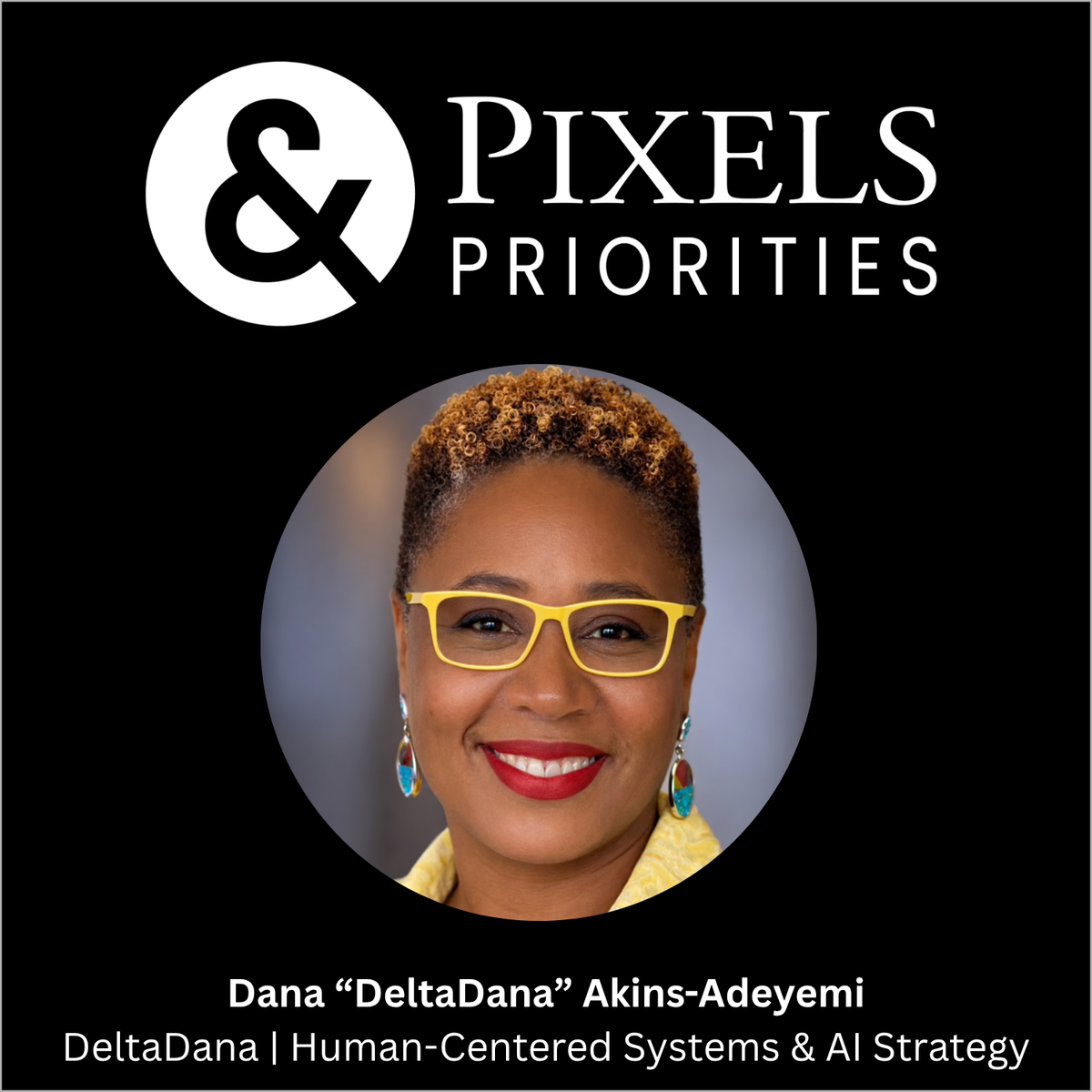
Dana “DeltaDana” Akins-Adeyemi joins us to explore burnout prevention and recovery. We also examine how bias, exclusion, and toxic environments intensify burnout for marginalized professionals, making supportive communities, allies, and workplaces where people genuinely belong even more important.
🎧 Listen to this episode on Apple Podcasts, Spotify, or your favorite platform.
Burnout Prevention Starts Before the Floor Drops
Many of us treat community the way we treat an emergency kit.
You and I know community is useful. We intend to build one eventually, and then something goes wrong, like the job disappears, the team changes, or the pressure becomes unsustainable. We may hesitate to reach for support or find that the support structures were never given time to develop.
“Build community before the floor drops.” — Dana “DeltaDana” Akins-Adeyemi
When in periods of severe stress, my instinct early on was to put my head down and solve the problem alone. I have a long history of figuring things out, so self-reliance felt responsible and familiar.
Looking back, I can see how resistance to asking for help often deepened my burnout.
“Just because I have a history of figuring things out doesn’t mean I had to keep making that choice.” — Metsy Rose
In our conversation with Dana “DeltaDana” Akins-Adeyemi, we explored the practical side of burnout: what individuals, colleagues, mentors, and leaders can do before stress becomes a full system shutdown.
Community Is Infrastructure, Not Emergency Networking
Your professional community can include current and former coworkers, mentors, sponsors, industry peers, friends, family members, faith communities, and people who understand parts of our experience that may be invisible at work.
DeltaDana described hosting tea parties that bring tech women together, including women who know what it feels like to be the only woman or the only Black woman in a professional environment.
Your community is not simply a job-search network. It is a place where we can reconnect with parts of ourselves that work does not always recognize.
For product managers and UX professionals, our careers depend heavily on relationships, context, communication, and collaboration. Yet many of us neglect our own relational support while spending our days creating alignment for everyone else.
Community becomes more resilient when we participate before we need something.
That can mean:
- Sharing an opportunity while we are securely employed
- Introducing two people who could help each other
- Staying connected when a coworker leaves
- Attending an industry gathering without an immediate ask
- Offering knowledge, encouragement, or perspective
- Creating spaces where people can talk honestly about work
J described years of building creative communities and noticing that some people returned only after losing a job. There is nothing wrong with seeking help during a crisis. A relationship built through consistent contribution, however, gives everyone a stronger foundation when careers enter one of their inevitable valleys.
“I think you attract the people that represent the community that you create.” — J Schuh
Clarity and Boundaries Are Burnout Prevention
Burnout prevention is not limited to meditation apps, vacation policies, or personal resilience. The everyday design of work matters.
Confusion creates cognitive load. Constant pivots create anxiety. Messages sent late at night can create expectations even when the sender never explicitly asks for an immediate response.
As a colleague and leader, I try to reduce those pressures in small ways. I schedule messages outside of normal hours to be delivered the next morning. When I cannot schedule an email or a chat, I may explicitly state that no response is needed until the following day. I actively seek clarity and share information that helps other people understand what is happening.
These small actions will not repair a deeply unhealthy organization, but it can establish healthier team-level norms.
The same principle applies to honesty. A leader does not need to pretend everything is calm when the team can plainly see that it is not.
We can be transparent in our communication. A more trustworthy message might sound like this:
We have asked for too many pivots lately, and I can see that is creating pressure. I am working to reduce it, and we also need to discuss how we will manage the current reality together.
A shift in messaging does not remove the difficulty the team is faced with, but it can alleviate uncertainty and the additional strain of being expected to deny it.
Trust Is Built Through Small Moments
We often talk about trust as though it arrives during a major crisis. In practice, trust accumulates through ordinary interactions.
A thoughtful comment in a meeting can be acknowledged immediately. A colleague can be thanked for raising a concern. A manager can notice that someone is carrying more than usual and ask what support would be useful.
I think of these as micro-trust moments.
“Those are the micro trust moments of letting someone be seen and feel seen so that when the tough times do hit, you’ve already laid that groundwork.” — Metsy Rose
People share risks earlier when they trust the response.
Designers raise accessibility concerns sooner.
Product managers admit uncertainty before an assumption hardens into a roadmap.
Researchers surface inconvenient evidence.
Team members ask for help before exhaustion becomes collapse.
Trust improves the quality of the work because it makes important information safer to share.
Mentorship Protects Perspective and Identity
Burnout can shrink our field of vision until one job feels like the entire world.
A mentor can help widen the frame again.
DeltaDana described mentorship as more than career advice. A mentor can share experiences, remind someone of their longer-term goals, and help them remember that there is life beyond one company or role.
“You don’t want to lose your identity in your job.” — Dana “DeltaDana” Akins-Adeyemi
Our professional identities can become entangled with performance, expertise, and the products we help create.
Mentors and trusted peers can remind us that our judgment, curiosity, relationships, and accumulated experience travel with us.
Sometimes community does more than support our identity. It helps us recover it. Trusted colleagues can help remind you of your identity when it gets lost in the shuffle of massive change.
Culture, Burnout, and Impacts to Marginalized Groups
Not every workplace is healthy for every person.
A culture that feels energizing to one employee may be exhausting to another. That does not mean either person is an issue to be fixed. It means cultural fit includes communication norms, psychological safety, leadership behavior, belonging, recognition, and the amount of unnecessary friction someone must absorb to do their job.
DeltaDana spoke candidly about navigating racism and sexism as a Black woman in engineering. The technical work was not the hardest part. The surrounding culture created battles unrelated to the work she was there to perform.
“Culture is probably number one.” — Dana “DeltaDana” Akins-Adeyemi
For people on the margins, culture is not an office perk. It can determine how much energy remains available for creativity, problem-solving, and career growth.
Bias, exclusion, and toxic environments intensify burnout for marginalized professionals, making supportive communities, allies, and workplaces where people genuinely belong even more important.
Organizations that want strong product and design professionals cannot focus only on recruiting talent. They must build environments where talented people can flourish without spending their best energy proving they belong.
AI Can Assist Without Becoming Community
AI can sometimes help reduce workload. Used thoughtfully, AI can give us a strong starting point when our cognitive capacity is low.
AI is simply a tool, and it cannot replace a mentor who understands your history, a colleague who notices that you are struggling, a therapist who provides professional support, or a friend who has a real relationship with you.
The more conversational these systems become, the more important it will be to remember the difference between responsive software and reciprocal human care.
AI may help us organize the work. It cannot do our living together for us.
Practical Ways to Build Support Now
You do not need to redesign your entire life or organization this week. Start with something small and repeatable:
- Contact one former colleague without asking for anything
- Recognize a teammate’s contribution while the moment is fresh
- Schedule nonurgent messages for working hours
- Ask a mentor for perspective rather than waiting for a crisis
- Identify which parts of your identity exist outside your role
- Notice whether your workplace appreciates you or merely tolerates you
- Create one recurring space for honest human connection
Burnout has individual, relational, and organizational dimensions. Our responses need all three.
Questions for Reflection
- Which relationships would you rely on if your work changed tomorrow, and how are you nurturing them today?
- What small leadership behavior could create more clarity or trust for your team this week?
- Does your workplace allow you to do your best work, or are you spending too much energy surviving its culture?
Key Takeaways
- Community is most useful during a crisis when it has been built before the crisis.
- Clarity, boundaries, and honesty are practical forms of burnout prevention.
- Trust grows through small, repeated moments of recognition and safety.
- Mentorship helps people maintain perspective and an identity beyond their current role.
- AI can assist with work, but it cannot replace reciprocal human connection.
Final Thoughts
My personal philosophy is that humans are meant to do life together.
That does not mean every relationship will be easy or that community eliminates burnout. It means isolation should not be our default strategy for surviving difficult work.
We can build relationships before we need rescue. We can create trust before the stakes become high. We can establish boundaries before exhaustion makes them unavoidable. We can help people remember that they are more than a title, a backlog, or a company’s decision.
The floor will move again... our work realities almost guarantee it.
The question is whether we will be standing alone when it does.
– Metsy
Co-host, Pixels & Priorities
Stay Connected
🎧 Listen to new episodes every Tuesday on Apple Podcasts, Spotify, or your favorite podcast platform. Please leave us a rating, submit a review, and share with a friend. It helps more people find the show and join the conversation.
Connect on LinkedIn: Metsy Rose | J Schuh | Pixels & Priorities