
030 Who's Responsible for AI Upskilling?
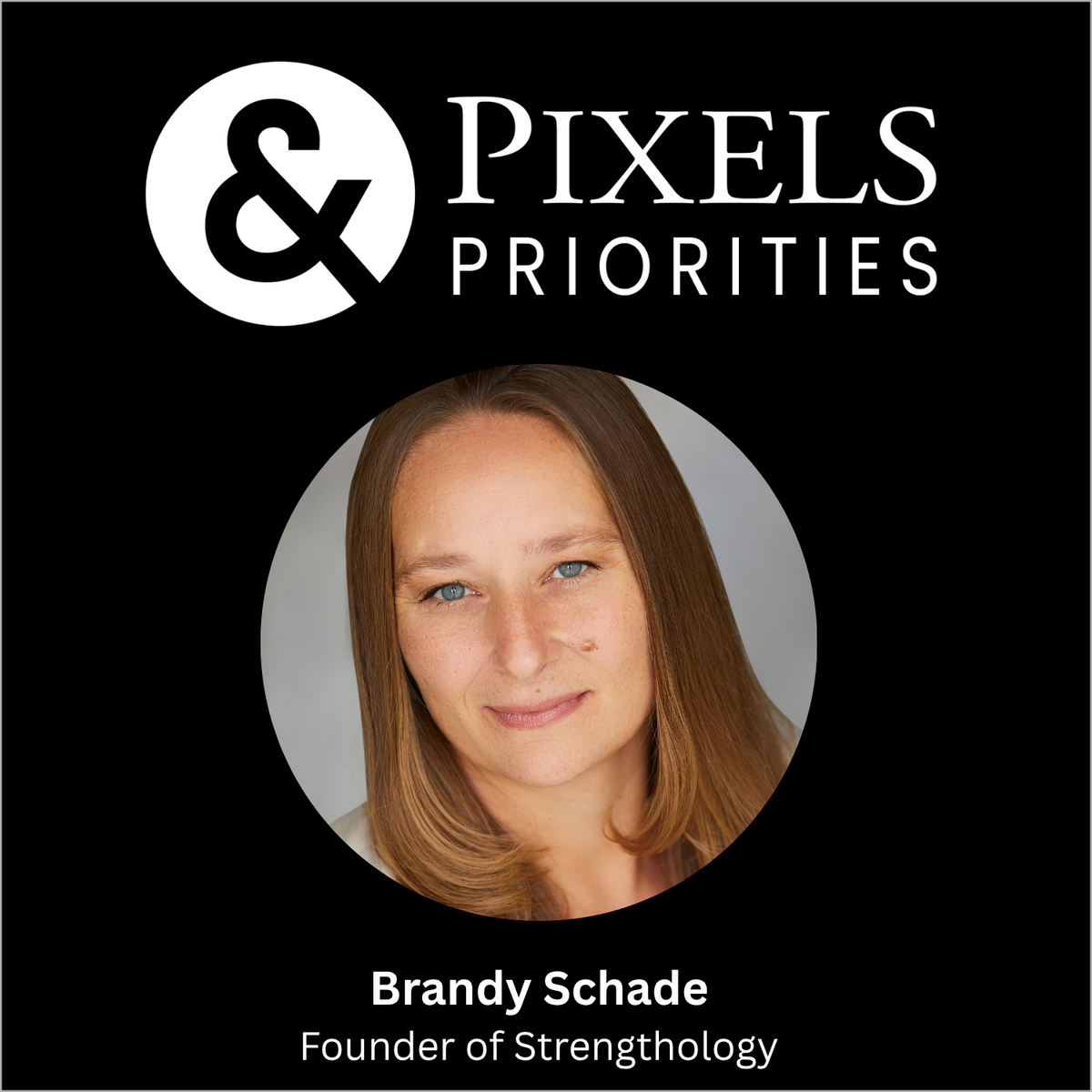
Brandy Schade joins Metsy and J to explore AI uncertainty, strengths-based learning, and why building AI capabilities requires more than individual effort. What can leaders do to help entire product and design teams adapt?
🎧 Listen to this episode on Apple Podcasts, Spotify, or your favorite platform.
Everyone needs to learn AI.
I'm hearing that message from every direction. Product managers are being encouraged to automate workflows. UX designers are exploring AI-assisted research and design. Leaders are looking for productivity gains, and organizations are asking employees to develop capabilities that may not have existed in their roles a year ago.
There's an uncomfortable question underneath all that urgency though:
If AI is becoming essential to how an organization operates, why are so many employees expected to figure out how to learn it on their own?
In our latest Pixels & Priorities conversation, J and I welcomed Brandy Schade, founder of Strengthology, to explore uncertainty, adaptability, and the role our individual strengths play in navigating change.
We started by talking about how people respond to an unpredictable future. We ended up discussing something I believe deserves much more attention in product management, UX design, and organizational leadership.
Learning AI is important. Helping the entire organization learn how to use AI effectively is a different challenge.
And that second challenge belongs to leadership.
The AI Skills Gap Is Also a Leadership Gap
When organizations talk about AI adoption, the conversation often centers on selecting tools, identifying efficiencies, and encouraging employees to experiment.
Yet adopting technology and building organizational capability are not interchangeable.
AI adoption is the process of incorporating artificial intelligence into work. AI upskilling is the development of the knowledge, judgment, and practical skills people need to use those tools effectively.
An organization can invest in AI technology without meaningfully investing in its people.
Brandy challenges leaders to recognize their responsibility:
"It's our job to upskill and train our people to do the things we need them to do as leaders." — Brandy Schade
If a team isn't developing the capabilities leadership expects, we should examine more than individual initiative. Have we explained which capabilities matter? Have we created opportunities to practice? Have we connected training to actual work?
J raised another concern during our conversation. When employees independently choose AI courses and learning resources, much of what they study may not align with the organization's needs.
The result can be motivated people acquiring disconnected knowledge, while teams continue struggling to collaborate effectively.
For product and design leaders, a shared learning direction is just as important as access to learning resources.
Not Everyone Learns, Adapts, or Finds Motivation the Same Way
CliftonStrengths is a strengths assessment developed by Gallup that helps individuals identify recurring patterns in how they think, feel, and behave.
Brandy built Strengthology, which leverages CliftonStrengths, around helping people understand and apply their strengths, including understanding the people they work with.
This becomes especially relevant when we're asking entire teams to develop new skills under pressure.
J described how his "Futuristic" strength influences the way he approaches uncertainty. While some people experience the unpredictable future as threatening, he often finds the possibilities stimulating.
Brandy explained that different strengths can influence how someone approaches learning.
Someone with a strong "Learner" theme might enjoy taking a course. Someone with "Input" might begin by gathering information. Someone with "Woo", a strength associated with connecting with people, might find a group learning experience more motivating.
As Brandy explained:
"We all have to do certain things in life. We all have to get similar results, but we all come at it very differently." — Brandy Schade
This remains important when we're designing AI training programs.
The goal doesn't necessarily need to change, but the path someone takes to reach it can.
J raised a question worth considering in our own professional development:
"How might I use AI in a way that actually multiplies the value that I bring to the table with what I'm good at naturally?" — J Schuh
Rather than expecting every product manager or designer to become an AI expert in the same way, perhaps we should be helping people connect AI capabilities to the work they already do well.
Uncertainty Doesn't Disappear Before We Take Action
There's another challenge we have to acknowledge. Sometimes the number of options becomes its own obstacle.
Which AI model should we learn? Which course should we take? What if we invest time in a tool that becomes obsolete? What if we choose the wrong approach?
Brandy's response to that uncertainty was practical: take an action, learn from it, and adjust.
She also acknowledged that the larger an initiative becomes, the more carefully we must consider the cost of changing direction.
An individual testing an AI workflow and an organization rolling out AI across an entire department are making decisions with very different consequences.
For small, manageable experiments, we can learn through action. For broader implementations, we need to evaluate the implications of our choices.
The common thread is adaptability.
Waiting for complete certainty isn't realistic in a rapidly changing environment. We need to develop the ability to make thoughtful decisions with incomplete information, recognize what we've learned, and change direction when necessary.
Individual Learning Becomes More Valuable When We Share It
We then talked about how training actually happens at work.
I shared an experience with Atlassian Rovo introducing agents into Jira.
Rather than waiting for a formal training program, I started experimenting. After creating three agents, I reached out to fellow product managers so we could get on a call and explore them together.
It wasn't a months-long training initiative. It was an opportunity to learn something useful and immediately share it.
"Knowledge with one person doesn't do anything for a company." — Brandy Schade
A single product manager might discover an effective way to use AI in an existing workflow. A UX designer might experiment with a tool that helps with part of the design process.
Those individual discoveries can be useful. Their organizational value grows when colleagues can understand, evaluate, and build on them.
This is where informal knowledge sharing becomes a meaningful complement to structured training.
We need both.
Formal training helps establish common foundations, expectations, and appropriate ways of using tools. Informal learning helps teams exchange discoveries while those tools and practices are evolving.
Learning Is Productive Work
Brandy also challenged a workplace assumption that I think many of us have experienced.
When teams are constantly focused on delivery, taking time to learn can feel like stepping away from productive work. Yet learning something valuable may allow us to work more effectively later.
J shared a story from earlier in his career. While working in an animation studio, he realized the team had more projects than it could handle. Rather than waiting for someone else to become available, he opened a book and started learning Flash.
That decision eventually led him to develop significant expertise, work with Macromedia's development team, open his own animation studio, and teach at a university.
His story illustrates how the decision to stop and learn can change what we're capable of contributing.
Not every experiment will lead to that kind of career transformation. That's not the point.
The time we invest in developing capability should not automatically be treated as time lost from delivery.
For product and design leaders, that means making learning an intentional part of how teams work, rather than an additional expectation squeezed around existing responsibilities.
What Can Product and UX Leaders Do Differently?
It's important to think about how we can create more practical opportunities for AI learning inside teams. A few approaches stand out:
- Start with actual work. Identify a meaningful product management, UX, or operational challenge that AI might help address.
- Recognize different learning approaches. Give people opportunities to explore independently, collaborate with a colleague, or learn in a group.
- Make room for experimentation. Allow time to test manageable ideas without expecting immediate mastery.
- Create opportunities to teach each other. Encourage people to demonstrate useful discoveries instead of keeping that knowledge within individual workflows.
- Build shared understanding. Help product, design, business, and technology teams develop a common language around AI capabilities, limitations, and expectations.
These don't eliminate the need for more structured organizational training.
They give us ways to begin building capability while longer-term learning programs are being developed.
Questions for Reflection
- Are we giving people meaningful time to learn AI, or expecting them to develop new capabilities on top of an already full workload?
- Do our training opportunities recognize how differently people approach uncertainty, motivation, and learning?
- When someone discovers a useful AI workflow, how does that knowledge become accessible to the rest of the team?
Key Takeaways
- AI adoption is a people challenge as much as a technology challenge. Access to tools doesn't automatically create organizational capability.
- Leadership owns an important part of upskilling. People need direction, support, and opportunities to develop relevant skills.
- Different strengths support different learning paths. A shared goal doesn't require an identical approach.
- Small experiments create opportunities to learn. Action, reflection, and adaptability can help us navigate uncertainty.
- Shared learning creates organizational value. Training and collaboration help individual discoveries benefit entire teams.
Final Thoughts
I don't think uncertainty is something we'll eventually solve and leave behind.
For those of us working in product management, design, research, and technology, uncertainty has always been part of the work. AI is making that reality harder to ignore.
As I reflected at the end of our conversation:
"We need to learn, share knowledge with each other, and raise the capability of the whole group." — Metsy Rose
We can continue investing in our individual skills while recognizing that our organizations also have a responsibility to help people navigate change together.
The question isn't simply whether your team is learning AI. It's whether you're building an environment where that learning can happen and benefit everyone.
I'd love to hear how other product and UX teams are approaching this. Are your organizations creating time for learning and sharing knowledge? Or is AI upskilling largely an individual responsibility?
Join J, Brandy, and me for Episode 030 of Pixels & Priorities as we explore strengths, uncertainty, AI adoption, and the importance of learning together.
– Metsy
Co-host, Pixels & Priorities
Stay Connected
🎧 Listen to new episodes every Tuesday on Apple Podcasts, Spotify, or your favorite podcast platform. Please leave us a rating, submit a review, and share with a friend. It helps more people find the show and join the conversation.
Connect on LinkedIn: Metsy Rose | J Schuh | Pixels & Priorities